
Applied Bioinformatics and Genome Research
Research
Before a newly sequenced genome is useful for research, it has to be annotated: where are the genes, how are they built from exons and introns, what do they do, and which regions are repeats? Our group develops the software for these steps and applies it in collaborations.
Our work falls into four topics that build on each other. The basis is a gene finder that uses deep learning. We extend it to metagenomes, add functions to the predicted genes and annotate repeats in the same model. The result should be a single pipeline that is easy to install and keeps up with the number of genomes in the Earth BioGenome Project.
Genome annotation
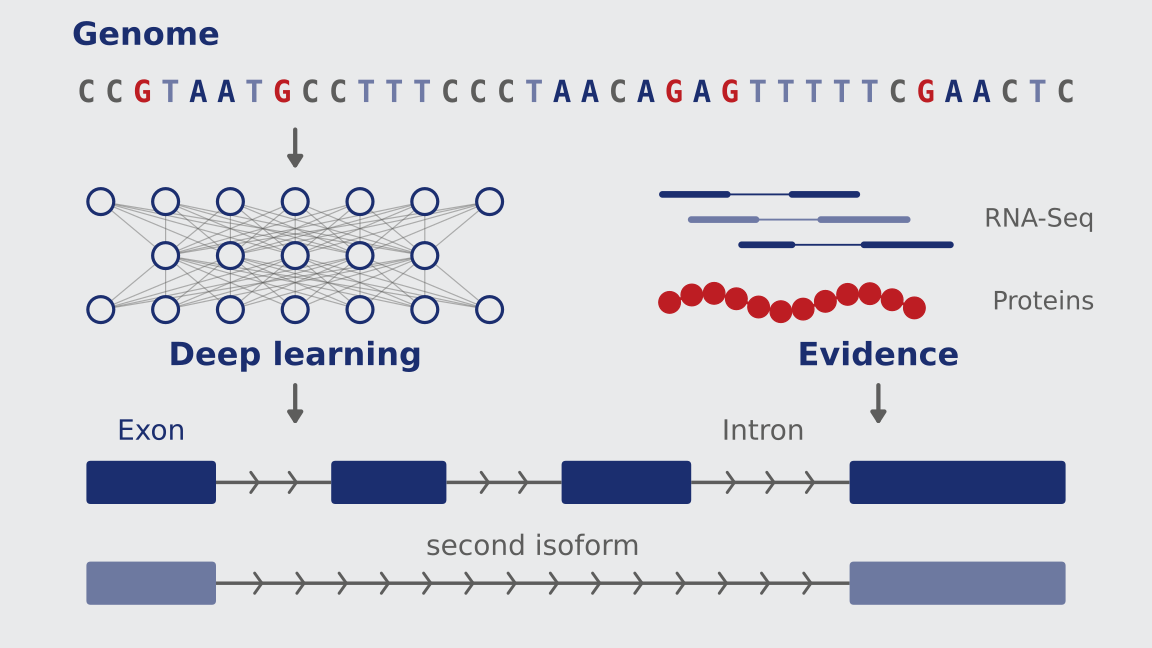
Structural annotation of protein-coding genes determines where coding exons and introns lie. It is the basis for functional annotation and evolutionary analyses. For a long time it relied on hidden Markov models such as AUGUSTUS and GeneMark. These have to be trained for each new species and only become accurate with additional data from transcriptomes or protein databases.
With the pipelines BRAKER1, BRAKER2, BRAKER3 and BRAKER4 we automated this training. Galba and GALBA2 use the fast protein aligner miniprot to obtain training genes and hints from protein sequences. Tiberius is a gene finder that combines deep learning with a trainable HMM layer. In the human genome it reaches the accuracy of BRAKER3 and BRAKER4 without additional evidence, and it annotates a mammalian genome in about two hours on a single GPU.
In the DFG project AI-GUSTUS we extend Tiberius and Vipsania with evidence from transcriptome and protein data and with the prediction of alternative splice isoforms. This new pipeline is called Paludamentum. It is the coat around the deep learning gene finders that we develop in cooperation with the group of Prof. Mario Stanke. The software is open source, written in Nextflow and Python, and runs in containers on HPC clusters and in the cloud.
Applied Bioinformatics
We bring our methods into biological projects. This includes genome assembly and annotation, and advice on transcriptome analyses and population genomics.
Some examples: we annotated 49 diatom genomes with one uniform workflow and are currently annotating hundreds of vertebrate genomes with deep learning and evidence. In infection research we contributed to the analysis of the global spread of Klebsiella pneumoniae ST395 and to studies on Streptococcus pyogenes. In the BMBF project AI-Biome we developed methods for the early detection of pathogens in dairy farm environments.
We help shape international standards: on the annotation committee of the Earth BioGenome Project, in the European Reference Genome Atlas (ERGA) and on the scientific advisory board of OrthoDB.
Eukaryotic metagenomics
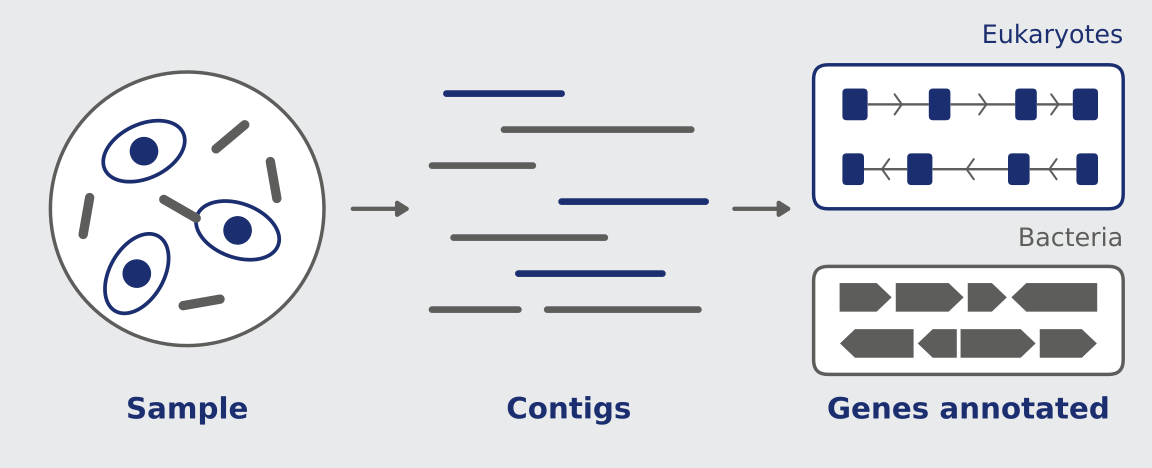
Many ecologically important eukaryotes are known only from environmental samples. In metagenomes their sequences often cannot be assembled into complete genomes. The usual workflows come from prokaryote research and fail on the more complex gene structures and the many repeats of eukaryotes. Incomplete bins and single contigs therefore mostly stay unannotated.
We are developing a scalable Snakemake workflow for eukaryotic sequences in metagenomes. It combines established tools with tools built specifically for eukaryotes, such as the deep learning gene finder Vipsania (Krieg et al., 2026). We also study how to use low-coverage metatranscriptome data and whether a foundation model can deliver the taxonomic placement of a sequence along with the genes.
We test the methods on two kinds of samples. One is long-read metagenomes of phytoplankton blooms in the North Sea, in collaboration with the Greifswald research on marine polysaccharide utilization (POMPU). The other is rumen metagenomes of dairy cows that are fed algae in the Alg4Nut consortium, where the protists and fungi of the rumen are our main interest.
Functional and repeat annotation
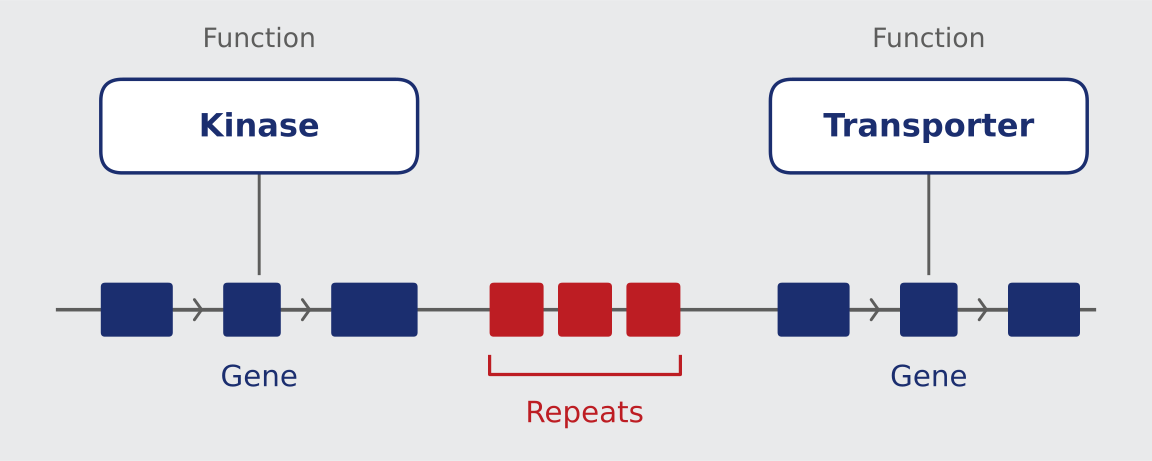
A genome annotation is complete only when the genes carry a function and the repeats are described.
Deep learning tools such as FANTASIA (Martinez-Redondo et al., 2025) assign GO terms to proteins much faster and more often than older methods. For submission to GenBank or ENA, however, every gene needs a product name that follows strict rules. Together with the FANTASIA team we are working on a module that derives valid product names from GO predictions, and we are building functional annotation into our pipeline. Fewer genes should then end up as "hypothetical protein".
For repeat annotation, today's standard, RepeatModeler2 followed by RepeatMasker, can take more than 72 hours for a mammalian genome. We are extending the Tiberius architecture so that the model predicts genes and common repeat classes at the same time. We also test whether species-specific repeats can be detected with a genome foundation model.
Grant Projects
Heisenberg professorship
The DFG funds our department with a Heisenberg professorship (project number 567443876). We are developing a software system for genome annotation that builds on genome foundation models and can keep up with the millions of genomes of the Earth BioGenome Project. It is meant to annotate gene structures, gene functions and repeats in one run, including in metagenomes with single-celled eukaryotes. For functional annotation we work with Ana Rojas (CABD Seville) and Rosa Fernández (Metazoa Phylogenomics Lab, IBE Barcelona), for repeat annotation with Shujun Ou (Ohio State University) and Lukas Schrader (University of Münster)
AI-GUSTUS
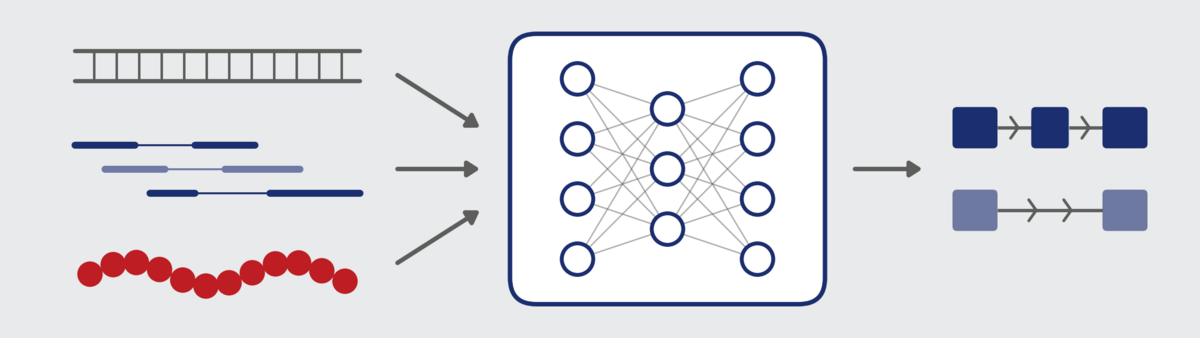
AI-GUSTUS is a DFG project (project number 552910312, 2024 to 2026). We are extending the gene finder Tiberius into a pipeline that uses transcriptome and protein data as evidence, predicts alternative splice isoforms and runs in the cloud. Our partners are Mario Stanke (Bioinformatics, University of Greifswald) and Tomas Bruna (DOE Joint Genome Institute).
Alg4Nut

Alg4Nut studies how algae farmed near the coast affect the rumen microbiome of dairy cows when added to their feed, and whether they lower methane emissions. The consortium is led by Mirko Basen (Microbiology, University of Rostock). It is funded from the European Regional Development Fund (ERDF) of the state of Mecklenburg-Vorpommern and runs from April 2025 to March 2029. We are an associated partner in the subproject of Dörte Becher (Microbial Proteomics, University of Greifswald). There we annotate the genomes of protists and fungi from rumen metagenomes so that metaproteomics can detect their proteins. More is on the Alg4Nut project page.
TRR 420 CONCENTRATE: A6 HOME
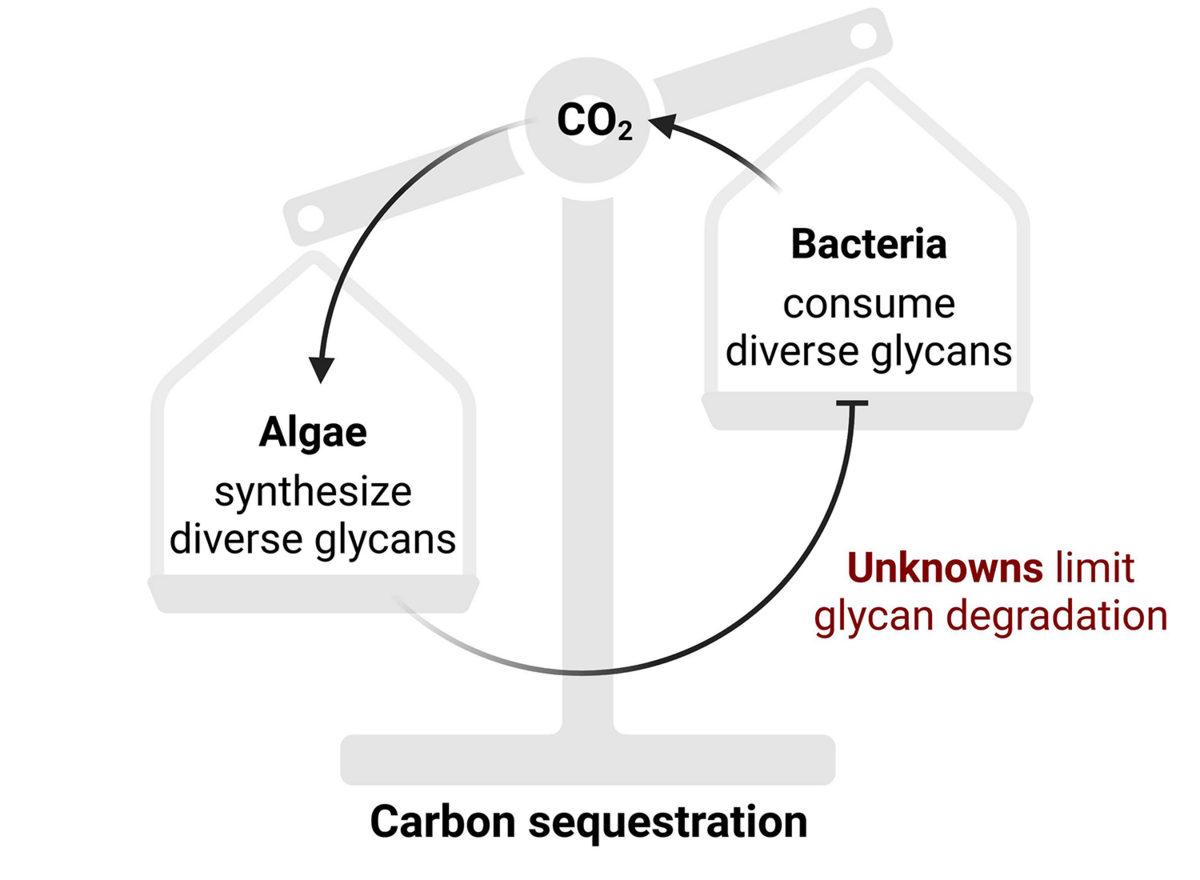
The collaborative research centre TRR 420 CONCENTRATE of the universities of Greifswald and Bremen studies why sugars from marine algae (glycans) persist in the ocean for a long time and so store carbon. The DFG has funded it since 2025. In subproject A6 HOME we work with Mia Bengtsson (Coastal Microbiomes, University of Greifswald). HOME tests the idea that algae make complex glycans to defend themselves against some bacteria and to feed others. For this we develop methods for eukaryotic sequences from environmental samples and annotate the genomes of algae and photosynthetic protists to understand how these organisms synthesize glycans.
GEvol
GEvol is the DFG Priority Programme 2349 on the genomic basis of evolutionary innovations. Within it we work with Erich Bornberg-Bauer (University of Münster) and Gregor Bucher (University of Göttingen) on the project "Functional annotation of genomic innovations in a densely populated clade with deep learning" (project number 503348080, second funding period). We develop deep learning methods that find new genes in insect genomes and assign functions to them. We test them on de novo genes, that is, genes that arose from previously non-coding DNA.
Web server
On our web server you can run tools such as Tiberius and AUGUSTUS in the browser without installing anything. We run it together with the group of Prof. Dr. Mario Stanke.
Software
Our software is open source and freely available. We develop it in close collaboration with the group of Prof. Dr. Mario Stanke and release it together in the GitHub organisation Gaius-Augustus.
- Tiberius: gene finder with deep learning and an HMM layer; annotates a mammalian genome in about two hours on one GPU.
- Paludamentum: Nextflow pipeline that annotates the protein-coding genes of a eukaryotic genome. It combines the ab initio predictions of the deep learning gene finders Tiberius and Vipsania with evidence from proteins, RNA-Seq and Iso-Seq into one gene set with alternative isoforms, UTRs and a quality report.
- BRAKER4: fully automated genome annotation with RNA-Seq and protein evidence, using GeneMark-ETP, AUGUSTUS and TSEBRA incl. downstream quality control outputs
- BRAKER: fully automated genome annotation with RNA-Seq and protein evidence, using GeneMark-ETP, AUGUSTUS and TSEBRA (the original Perl pipeline).
- GALBA2: genome annotation with miniprot and AUGUSTUS when only proteins of related species are available, incl. downstream quality control outputs.
- Galba: genome annotation with miniprot and AUGUSTUS when only proteins of related species are available (the original Perl pipeline).
- TSEBRA: selects from several gene predictions the transcripts best supported by evidence.
- Scribonia: tells from the DNA alone which of the codons TAA, TAG and TGA end translation in a genome or metagenomic bin, in about a second per megabase.
- MakeHub: generates assembly hubs for the UCSC Genome Browser automatically.
- pyVARUS: Python implementation of VARUS; samples complementary RNA-Seq reads from the Sequence Read Archive and aligns them.
Training material on genome annotation: Workshop on Genomics, Český Krumlov and BRAKER and TSEBRA workshop for ERGA. Material for data science courses: Data Competency.
Contact
Prof. Dr. Katharina Hoff
Applied Bioinformatics and Genome Research
Institut of Microbiology
Center for Functional Genomics of Microbes (C_FunGene)
Felix-Hausdorff-Straße 8, Office 0.63
17489 Greifswald
Germany
Telefon: +49 (0)3834 420 4624
E-Mail: katharina.hoff[at]uni-greifswald.de